Thursday, September 12, 2013

Salem Witch Trials 1692-1693

The Salem Witch Trials 1692-1693
Salem witch trial lithograph


     The Salem Witch Trials was an event that occurred in Colonial Massachusetts in the village
 of Salem.
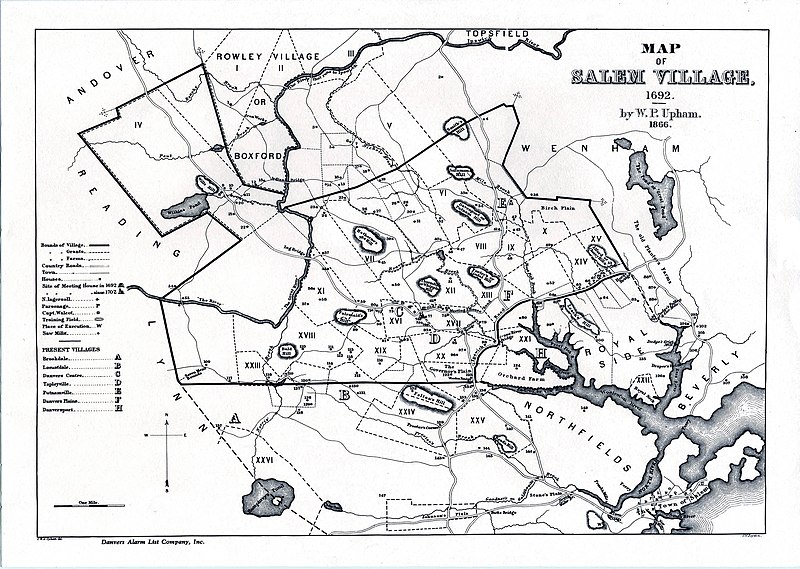
File:Salem Village - map of - Project Gutenberg eText 17845.jpg
 This event occurred between February 1692 and May 1693. In this event there was a series of prosecutions as people were being accused for the use of witchcraft. Witchcraft is the practice and belief of magic and in this case these people were being accused for devils magic meaning they had a secret alliance with the devil. These people who practiced witchcraft were known as witches and Christians believed that the devil will give them certain powers to harm people in return for his faithfulness. In 1689 the English rulers began a war between France and American colonies known as King William's War. The war destroyed many upstate regions including the Salem Village. This was a cause to the Salem With Trials because the war destroyed the region causing family rivalries as they fought over limited resources. In January 1692 Reverend Parris daughter Elizabeth and niece Abigail Williams they began having fits. these to young girls began to scream strange sounds and twist themselves into strange positions. The doctor blamed the supernatural for this kind of behavior. On February 29 these girls blamed three woman for their suffering and illness. Since the Christians believed that the devil is in fact on Earth and causes diseases and catastrophes. These three woman Tituba, a Caribbean slave, Sarah Good a homeless, and Sarah Osborne a old poor woman were acused of being a witch whom were servants of the devil.
    The Tituba and both Sarahs were the first of many accused of witchcraft. Out of the three Tituba agreed that she had came in contact with the devil. Tituba admitted that there was many more witches looking to kill the Puritans, so they were imprisoned. Later on another woman known as Martha Corey was accused of witch craft as well and was a loyal member of the church. The Puritans began to realize that anyone could be a witch. On May 27, 1692 Governor William Phipps called for a Special Court of Oyer and Terminer. In their first case with Bridget Bishop she was accused guilty and sentenced to death. She became the first of many to be killed and hanged at Gallows Hill a barren slope near Salem Village for hanging.
More than 200 people were accused of witchcraft and 20 were executed.
     Mostly all of these people were accused of
witchcraft due to spectral evidence. Spectral evidence is a type of evidence based on dreams and visions. The evidence was supernatural so for example a person can say a witch casted spells on them when that certain "Witch" was never even near that person. A man Known as Increase Mather who was a Puritan minister argued that spectral evidence was being misused. He wrote a letter to the court and published a book called Case of Conscience supporting his argument in 1693. This helped bring an end to the Salem Witch Trials as Governor Phipps and his wife began to be questioned about the witchcraft he put a stop to all arrest and vanished the Supreme Court of Oyer and Terminer on October 29, 1693. Eventually the colony realized they had made a mistake and paid the families of the ones convicted for their loss.


File:Increase Mather.jpg


Increase Mather


File:CasesofConscience1st.jpg

Friday, August 23, 2013

Maryland

File:Marycolony.png
 
 
     Maryland was an English colony founded in 1634 by Lord Baltimore. Maryland is a located in North America in the Mid Atlantic Region near Virginia and Pennsylvania. George Calvert 1st Baron Baltimore was of a prominent English Catholic family. Lord Baltimore originally wanted to create Maryland for it to be a Haven for English Catholics in the New World. A Haven is a sheltered place or a place of rest well secured. On June 12, 1632 Charles I of England granted the original charter of Maryland. About 12 million acres was granted to Lord Baltimore; however, some of Maryland's territory was lost in 1760s when Charles II granted some land of Pennsylvania to overlap Maryland. A reason on why Charles I wanted granted the colony of Maryland was to occupy Delaware River valley from the Dutch New World territory New Netherlands whom was England's rival at the time.
    On March 25, 1634 the first settlers arrived on St. Clement's Island. Maryland was name after Charles wife Henrietta Maria of France " Terra Mariae Angelice, Maryland". These settlers who landed on St. Clement's Island where led by Leonardo Calvert who is Lord Baltimore's younger brother. Leonardo Calvert later became the new colony's first governor. Some natives they encountered where the Yaocomico. The colonist purchased land from the Yaocomico Indians and founded St. Mary City's. However there were some conflict with Indians in 1642 the colony of Maryland declared war against the Susquehannok. The colony of Maryland was defeated in 1644 but in 1652 a peace treaty between the Susquehannok and the colony of Maryland was formed.
    Maryland's economy blossomed from the acres of tobacco. Tobacco was a major product shipped to Europe at some points in tobacco was used as currency. Maryland depended for labor to work on their tobacco fields the first workers were white indentured servants. These white indentured servants were penniless people who worked for years in order to pay for their passage from the Old World. In the late 17th century these indentured servants eventually changed to a large number of black of slaves that were imported. The main religion in Maryland was Catholicism but heavy tides of Protestants threated to submerge the Catholics. So with great support the Catholics of Maryland supported the Act of Toleration which was passed in 1649. The Act of Toleration granted toleration to all Christians. Maryland sheltered more Roman Catholics than any other English colony in the New world.


Thursday, August 15, 2013

Pedro Menendez de Aviles

   Pedro Menendez de Aviles was a Spanish explorer and commander of a naval squadron born on February 15, 1519 in Asturias, Spain. In 1565 with permission from King Philip II him and his Spanish Navy voyaged to Florida to begin a form a colony. Pedro is the founder of St. Agustine a city located in North East Florida which was known to be the capital of Spanish Florida for two hundred years. Pedro became the first governor of Spanish Florida. Spanish Florida refers to the territory  which was under Spanish rule in Florida. Pedro also was the designer of the treasure fleet system which was used in the Spanish treasure fleet to bring goods and luxury from the new world to Spain. Pedro in his final years became governor of Cuba shortly after his arrival in Cuba.
   Pedro was sent to Florida to kill the French who had settled there and set Spanish rule in florida.  Pedro was on a voyage to Florida to destroy the French's Fort Caroline which was previous territory of Spain. The Catholic Spanish considered the French to be dangerous heretics. When Pedro settle into the shore on August 28, 1565 the feast day of St. Agustine Hippo he named the colony St. Agustine. Pedro then later on went to have the first Catholic mass in the new world and continental United States. On September 20 ,1565 Pedro led an attack against the French at Fort Caroline they went to over throw and later on gained the fort and coast in Spanish hands. Fort Caroline was a French colony located in modern day Jacksonville, Florida. Pedro had nearly killed all the French when he took over and he imprisoned the captured French.
   Pedro wanted to be sure that Florida remained under Spanish rule. In order for this to happen Pedro explored up and down the coast of the Atlantic shores. In 1566 Pedro had watchtowers built to guard at Cape Canaveral and Bicayne Bay. Pedro then explored to what is now Paris Island, Carolina and that city became the capital of Spanish Florida named Santa Elena. Pedro was a man who encouraged his religion to the Native Americans. One of his goals was to convert Native Americans to Catholics, so he requested more priest and settlers. Pedro died in Santander, Spain on September 17, 1574 before coming to Florida to bring more settlers.